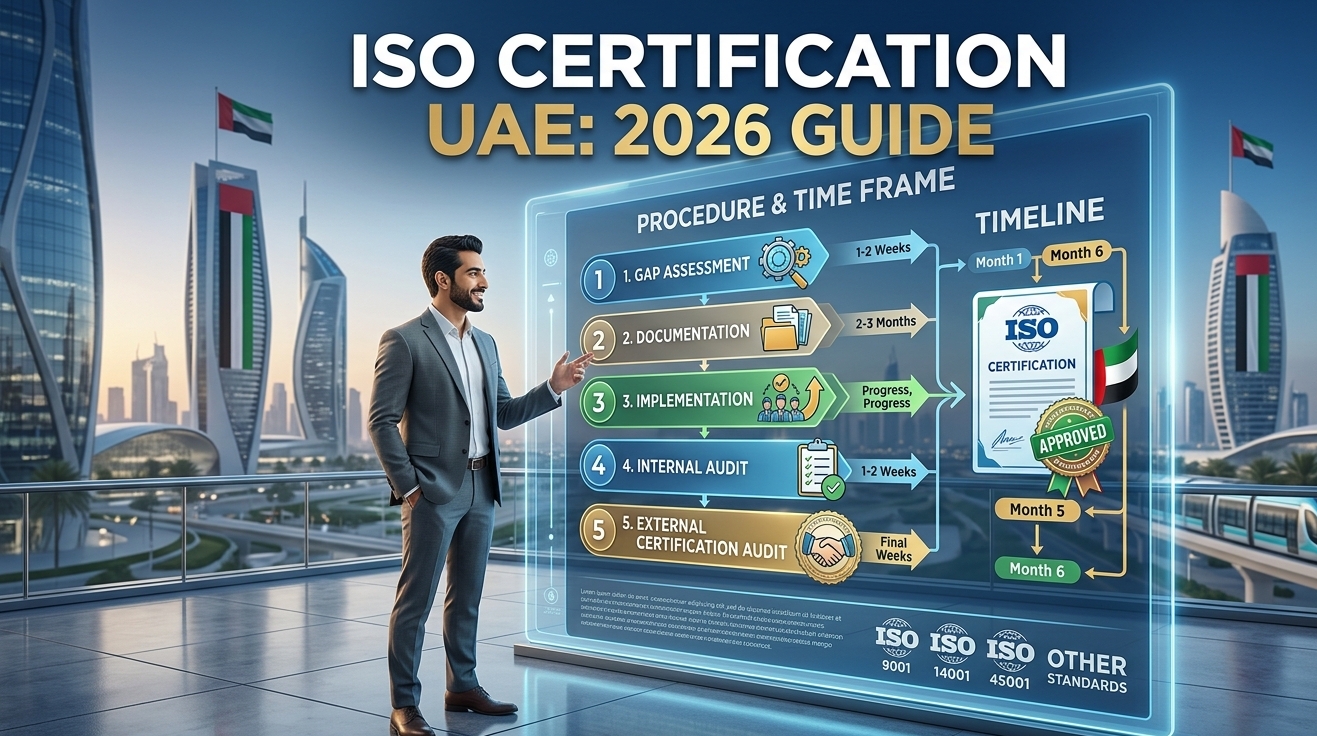
ISO Certification in Dubai: The Complete Guide
Wiki Article
ISO Certification Of Abu Dhabi: A Practical Guide For Local Companies
Business in Abu Dhabi is a tense environment, with its own set of pressures in relation to ISO certification. This is shaped by the presence of government-owned entities, large industrial players, and strict tendering requirements. For local businesses navigating their first ISO certificate, understanding the specifics of Abu Dhabi makes the process much easy and daunting.Government and Semi-Government Tenders Determine the Standard
A large proportion of Abu Dhabi's economic activity is conducted by institutions linked to the government as well as large industrial companies, many of which have formalised ISO certification as an essential prequalification requirement for contractors and suppliers. This means that the decision to go after certification is usually driven less by internal ambition and more by the actuality of what contract a business is hoping to stay eligible for.
The energy and industrial sectors have Specific Expectations
Abu Dhabi's industrial and energy sectors have extremely high standards around safety and environmental management in light of the magnitude and nature of the risks involved in these areas. Companies that offer services to this environment, even indirectly, often discover that the requirements for certification from the clients they directly deal with are more stringent than their baseline normal requirements, which reflects the organization's own internal policy on risk-management.
Making a choice that's compatible with Your Actual Business
A common mistake that people make is attempting to get a certification when the competitor does, without first mapping which standard really matches the company's risks and customer expectations. Logistics companies' priorities are significantly different than those of a management company for facilities, and starting with a clear-eyed assessment of what clients or tenders actually need will help avoid a lot of in the long run.
There is a Gap Assessment Stage Is Worth Taking Seriously
Before formally implementing it is essential to conduct a gap-analysis in relation to the relevant standard will show how much practice corresponds to requirements and where the need for real change is. Avoiding or speeding up this process leads to a longer stage of implementation that costs more later, since gaps that might have been discovered early however, they are revealed during the audit within the audit.
Documentation Requirements Can Be Managed Better Than They Appear
Many first-time applicants assume ISO documentation requirements will be daunting, however modern management systems are less restrictive about documentation as the previous ones were rather focusing on proof that procedures are followed, rather than being merely documented. A practical approach to documentation focused on what the business wants to monitor as a matter of fact, produces an organization that is actually used instead of one that's purely for audit purposes.
The options for local support have grown Definitively
Abu Dhabi now has a far more diverse pool of certified and consultants who have a real understanding of the local market than it did even five years ago. The result is that it has less the necessity of relying solely on international companies with no on-the-ground environment. This local expansion has generally helped make the process more efficient as well as more adaptable to specific realities of operating in the region.
Maintaining Certification Requires Ongoing Commitment
It's not just one thing to be achieved but a continuous commitment that involves periodic surveillance audits, which are typically each year, to determine if the management system is maintained. Companies that take the initial certification as the final step rather than the beginning point tend to struggle in future audits, while those who integrate the standards into their everyday practices will find recertification considerably more straightforward.
Free Zone businesses have to face some Particular Concerns
Companies that operate out of Abu Dhabi's diverse free zones have a tendency to believe that the requirements for certification are different when compared to enterprises in mainland countries, but the basic international standards are the same regardless of country. The only thing that differs is the specific expectations of the client and tender within each free zone's tenant system, which is essential to clarify with free zone authorities or prospective customers rather than thinking that any one answer is universally applicable.
Realistic Budgeting for the Whole Process
The first-time applicants often budget just for the fee of external audit which is usually not considered, leaving out the internal time investment as well as the possibility of consultancy fees, and adjustments to the operation that are required to fill in holes that were identified during assessment. A reasonable budget should cover the entire process from initial assessment until certificate the issue date, rather than only the invoice from the final audit so you do not get caught off guard midway through the process.
Timing of Certifications Around Business Cycles
Businesses that have clear seasonal peaks which are typical in the construction and sectors that deal with events, usually can schedule the more intense stage of implementation and the audit phase in quieter times, instead of attempting to implement the certification process in conjunction with peak operational demands. Certification bodies in Abu-Dhabi generally have flexibility in scheduling, and adjusting timing preferences earlier during the process can facilitate a more smooth experience for all those affected.
Inspiring Businesses from Companies That Have Had to go through it
In direct contact with other Abu Dhabi businesses in a similar field who have had certification can provide practical insights that neither certification or consultant will divulge unprompted, from realistic deadlines to elements of the audit are likely to catch first-time applicants off in the dark. This kind of knowledge gained from peer-to-peer relationships is incredibly valuable and should be investigating before committing to a certain provider or timeframe.
Working With Government Liaison Requirements
Businesses seeking certification specifically to make them eligible for government tenders to be awarded government contracts in Abu Dhabi should confirm exactly the certification scope and version that a particular tender requires in order to ensure that the requirements are not referring to specific editions or additional local standards that are different from the base international standard. Making sure to confirm this information in the tendering body prior to starting the process of certification eliminates the risk of signing certification against a scope that is not the correct one.
For Abu Dhabi businesses approaching certification for the first time, success generally is determined by determining the most appropriate standards for operational realities, taking the stage of preparation seriously and treating certification as an ongoing operational procedure rather than something to tick off once and forget about. Abu Dhabi businesses that approach certification with this level of preparation, instead of treating it as a last-minute request to be rushed through, generally end up with a more effective, actually useful management system at the end of the process. There is no need to be done on its own, because the growing pool of knowledgeable local consultants and certification bodies ensures a truly skilled assistance is more readily available than it was at any time in the past. Making use of this expanding local expertise base makes the whole journey much more manageable than it once was. Have a look at the best ISO 9001 Certification for site info.
ISO 20000 Certification: What It Means For It Service Providers In The UAE
As the UAE's IT service sector has gotten better, customers have become more demanding about how service providers actually manage their operations, not just the type of technology they employ. ISO 20000, the international standard for IT service management, has become an increasingly frequent method for UAE IT service providers to demonstrate that their service delivery is realigned and not reliant only on the capabilities of individual staff alone.What ISO 20000 Actually Covers
The standard discusses how an IT service company plans, offers it monitors, improves, and plans its services to clients, covering areas including crisis management, issue handling change management, and quality management. Rather than dictating specific technologies or tools providers are required to demonstrate a consistent, method of service delivery that isn't based upon any individual team member's individual experience.
Why clients are requesting it more frequently It
UAE businesses outsourcing IT services, whether it's infrastructure management, helpdesk assistance, as well as software development, need to be assured that the provider's service delivery process is maturing instead of being formally managed. ISO 20000 certification gives procurement teams an independently verified signal of this maturity, which reduces the need for sales presentations and references alone when evaluating prospective suppliers.
What is the difference between ISO 27001 and ISO 27001
IT providers are often under the impression that ISO 27001, the information security standard, covers similar issues to ISO 20000, but the two standards deal with completely different issues. ISO 27001 focuses specifically on protecting assets in the information system as well as managing security risk however, ISO 20000 focuses on the broad quality, uniformity, and security of IT service delivery, and the majority of UAE IT providers are pursuing both standards in order to cover these distinct but complementary areas.
Issue Management and Incident Management Get Particular Attention
Auditors who are assessing ISO 20000 compliance pay close focus on how a company responds to service issues when they happen, and how quickly they are identified and communicated to affected clients to be resolved, then analysed for recurrence. Any company that can show an organized, consistent procedure for handling incidents, as opposed to an improvised solution that changes depending on what personnel are available, is likely to be in compliance with this requirement much more convincingly.
Service Level Management requires real Measurement
The standard requires companies to define specific service level targets and to genuinely evaluate performance against them, and apply the data to improve instead of treating service-level contracts as static legal documents. This is why they need to have a solid internal monitoring and reporting capabilities that is usually one of the largest areas that first-time applicants have to work on during implementation.
This is the Certification Process in IT Services Providers
Like other management system standards, the way to ISO 20000 certification begins with an assessment of the gaps in standard's requirements. Then comes the installation of all necessary processes for documentation, monitoring capability, an internal audit, and a two-stage external certification audit. Regularly scheduled audits of surveillance ensure that the service management system remains operating and not just on paper.
Competitive Advantages in a Crowded Market
The IT services market in the United Arab Emirates is highly competitive, and ISO 20000 certification gives providers an unbiased, tangible way to differentiate themselves from competitors making similar claims regarding the quality of service and quality, without having any external proof behind them. For providers competing for greater, more sophisticated clients in particular, certification increasingly serves as a genuine base requirement rather than a secondary distinctive feature.
Integration of existing IT frameworks
Many UAE IT providers work within frameworks that are established, such as ITIL to provide guidance on how to manage services or ISO 20000. ISO 20000 aligns closely enough to these frameworks, so businesses who are already following ITIL practices often find much of the foundations needed for certification already in place. This overlap considerably reduces implementation efforts for those who have already invested in formalized practices for service management informally.
Special attention should be paid to Change Management.
The uncontrolled alteration of IT infrastructure and systems are the main cause of disruptions in service, and ISO 20000 places considerable emphasis upon structured change management practices to assess the risks and impacts prior to making changes instead of allowing random changes that can increase the probability of disruptions that occur unexpectedly and impact customers.
What clients should be looking for When evaluating the quality of a provider
The customers who evaluate IT providers who hold ISO 20000 certification should still be asking specific questions about how the ISO 20000-certified processes operate from day to day, instead of believing that certification alone provides a high-quality experience. A trusted and experienced provider is willing to go over specific examples of the way in which their incident management or change control procedure performed in an actual, real-world situation instead of speaking solely in general terms about the certification itself.
Watching the Future as the Stock Market Ages
As the UAE's IT service sector develops and client expectation for services increase, ISO 20000 certification seems likely to move from a differentiator toward a genuine benchmark expectation for businesses competing at the more sophisticated end that market, similar to the same pattern as ISO 27001 in information security. Companies that invest in real service management maturity now will likely be significantly better placed if that shift progresses.
Capacity Management Is Often Not Considered
Beyond incident and change management, ISO 20000 also expects organizations to think about future capacity needs instead of reacting just when performance problems are discovered. UAE service providers with rapidly expanding clients in particular benefit from the incorporation of this capacity planning strategy within their system for service management rather than treating it as an extra-curricular task.
When it comes to UAE IT service firms evaluating their options to determine if ISO 20000 is worth pursuing the certification provides a structured way to demonstrate an actual level of service management maturity to ever-more discerning customers, and also to highlight internal process weaknesses that, once addressed, tend to improve service delivery, regardless of the certification itself. For UAE IT companies serious about long-term competitiveness, building the kind and quality of standard of quality service delivery that ISO 20000 represents is likely to be more important in the future that it has been in the past. None of this needs to be re-created completely from scratch. Those already running reasonably structured operations frequently find that the groundwork already exists and simply needs formalising against the standard's specific specifications. The providers who begin this process in the near future will likely be better prepared as clients' expectations increase. Read the top ISO 9001 Certification for website tips.